
On-Page SEO Checklist for Beginners (2026 Edition)
Introduction
Imagine spending hours creating a website, publishing blog posts every week, and still seeing little to no traffic from Google. This is a situation many beginners face. They assume that simply publishing content is enough to rank. Unfortunately, that’s not how search engines work.
Google’s job is to deliver the most relevant and helpful content to users. If your page doesn’t clearly communicate what it’s about, search engines may struggle to understand and rank it—even if the information is excellent.
That’s where On-Page SEO comes in.
Think of On-Page SEO as preparing your content for both humans and search engines. It involves making strategic improvements to your page so visitors can easily consume the information while search engines can properly understand and index it.
The good news is that you don’t need to be an SEO expert to implement On-Page SEO. Most optimizations are straightforward once you know what to look for.
In this guide, you’ll learn a practical On-Page SEO checklist for 2026 that focuses on what actually matters. Whether you’re running a business website, a personal blog, or an eCommerce store, these techniques can help you build a stronger foundation for better rankings and more organic traffic.
What Is On-Page SEO?
Definition of On-Page SEO
On-Page SEO refers to all the optimizations you make directly on a webpage to improve its visibility in search engines.
Unlike factors that happen outside your website, such as backlinks or social mentions, On-Page SEO is entirely within your control.
Every page contains multiple elements that can influence rankings, including:
- Content quality
- Headings
- Images
- URLs
- Meta tags
- Internal links
- User experience signals
When these elements work together, search engines can better understand your page and match it to relevant searches.
Before learning how to optimize a page, it’s important to understand the basics of SEO. If you’re new to search engine optimization, you can start with our complete guide on What Is SEO?
On-Page SEO vs Off-Page SEO
A simple way to understand the difference is to compare it to opening a restaurant.
On-Page SEO is everything happening inside the restaurant. The menu, food quality, cleanliness, pricing, and customer experience all fall into this category.
Off-Page SEO is what people say about your restaurant outside the building. Reviews, recommendations, and word-of-mouth referrals are similar to backlinks and online mentions.
Both are important, but strong On-Page SEO should always come first. There’s little value in attracting visitors if the page itself isn’t optimized.
Benefits of On-Page SEO Checklist for Beginners
When done correctly, On-Page SEO can:
- Help pages rank for relevant searches
- Increase organic traffic
- Improve user engagement
- Reduce bounce rates
- Create a better browsing experience
Most importantly, it gives every piece of content a better chance of being discovered.
Complete On-Page SEO Checklist for Beginners
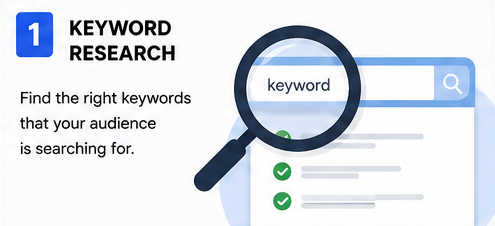
1. Start With Search Intent, Not Keywords
Many beginners make the mistake of choosing a keyword and immediately writing an article.
A better approach is to understand why people are searching for that keyword.
For example, someone searching for “On-Page SEO Checklist” is not looking for a sales page. They want a step-by-step guide they can follow.
Before writing, ask yourself:
- What problem is the reader trying to solve?
- What information are they expecting?
- How can I make my page more useful than competing results?
When your content satisfies search intent, rankings become much easier to achieve.
2. Build a Keyword Map for On-Page SEO Checklist
Instead of focusing on a single keyword, create a group of related terms.
For this topic, your keyword map might include:
- On-Page SEO Checklist
- On-Page SEO Guide
- SEO Checklist for Beginners
- On-Page Optimization Tips
- SEO Best Practices 2026
This approach helps search engines understand your content more comprehensively.
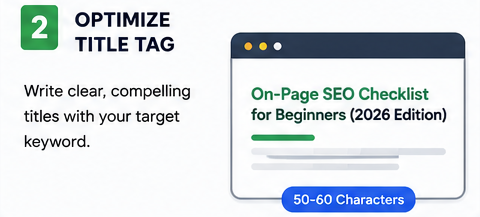
3. Create Titles That Earn Clicks for On-Page SEO Checklist
Ranking is only half the battle.
If nobody clicks your result, your traffic won’t grow.
A strong title should:
- Include the primary keyword
- Create curiosity
- Promise value
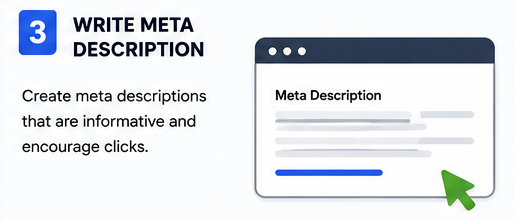
Compare these two examples:
Weak: On-Page SEO Guide
Stronger: On-Page SEO Checklist for Beginners (2026 Edition): 17 Easy Fixes That Matter
The second option gives users a clear reason to click.
4. Keep URLs Clean and Human-Friendly
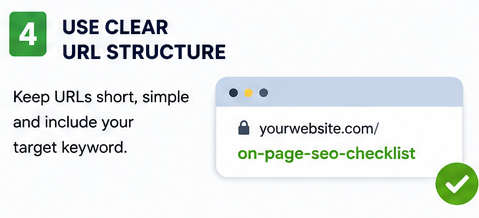
A URL should instantly tell users what the page is about.
Good example:
Souvix.in /on-page-seo-checklist
Poor example:
Souvix.in/post-457?id=82
Simple URLs are easier to understand, share, and remember.
5. Use One Clear H1 Heading for On-Page SEO Checklist
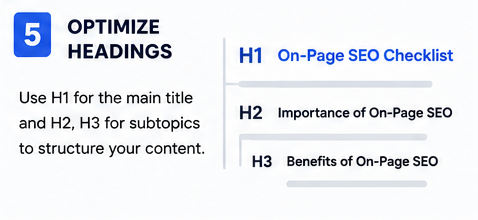
Your H1 acts as the main headline of the page.
It should clearly communicate the topic while naturally including the primary keyword.
Avoid creating multiple H1 tags because it can confuse the page structure.
Think of your H1 as the title on a book cover. Readers should know exactly what they’re about to learn.
6. Structure Content for Scanners
Most visitors don’t read every word.
They scan.
Large blocks of text often cause readers to leave before finding the information they need.
To improve readability:
- Use short paragraphs
- Add subheadings
- Include bullet points
- Break complex topics into sections
A well-structured article keeps readers engaged longer.
7. Create Content That Solves Real Problem
Google has become increasingly effective at identifying genuinely helpful content.
Instead of writing to hit a word count, focus on answering questions.
Ask yourself:
“What would a beginner need to know after reading this article?”
When readers leave with a solution, you’ve created valuable content.
8. Place Keywords Naturally
Keywords should fit into the content naturally.
Good locations include:
- Title
- Introduction
- Subheadings
- Image alt text
- Conclusion
If the keyword sounds forced, rewrite the sentence.
Modern SEO is about relevance, not repetition.
9. Strengthen Your Internal Linking
Every blog post should connect with other relevant pages on your website.
Internal links help:
- Search engines discover pages
- Visitors explore more content
- Spread authority across your site
A strong internal linking strategy turns individual articles into a connected content ecosystem.
10. Optimize Every Image
Images contribute to both SEO and user experience.
Before uploading an image:
- Compress the file size
- Rename the file descriptively
- Add relevant alt text
For example, “seo-checklist-2026.jpg” provides more context than “image1.jpg”.
Optimized images can also help generate traffic from image search results.
Free Tools to Improve On-Page SEO
Google Search Console
Monitor website performance, indexing, and keyword visibility.
Google Analytics
Track user behavior and identify content opportunities.
Yoast SEO
A popular WordPress plugin for improving On-Page SEO.
Rank Math
A powerful SEO plugin that offers advanced optimization features.
Google PageSpeed Insights
Analyze page speed and receive recommendations for improvement.
Conclusion
On-Page SEO isn’t about tricking search engines. It’s about making your content easier to understand, easier to navigate, and more valuable for users.
The websites that consistently rank well are often the ones that focus on fundamentals. They create useful content, organize information clearly, and provide a smooth user experience.
If you’re just getting started, don’t try to implement everything at once. Pick a page, apply this checklist, and gradually optimize the rest of your site.
Small improvements made consistently can produce significant results over time.
In 2026, strong On-Page SEO remains one of the most reliable ways to build long-term organic traffic. The sooner you start applying these practices, the sooner your website can begin earning the visibility it deserves.
A well-optimized website is just one part of digital success. Explore our Digital Marketing Services in Tricity to grow your business online.